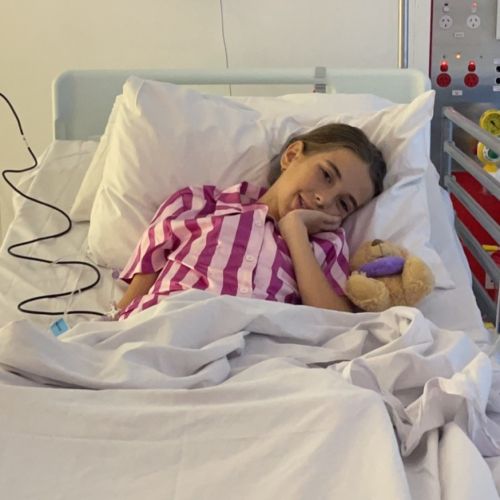
When Holly was approaching her first birthday, parents Raelene and Brett noticed that she wasn't crawling or talking. Concerned that their daughter wasn’t meeting the milestones their two older children had, they started investigating.
After two years and lots of tests, the close-knit family of five had the world ripped from underneath them, being told their healthy, cheeky and bubbly baby had a rare neurological disorder known as Rett syndrome.
“The diagnosis was the worst day of my life. I collapsed in the hospital,” said Holly’s dad, Brett.

Affecting 1 in 10,000 girls worldwide. Rett syndrome is a genetic disorder almost solely occurring in females. The disorder affects the brain and over time causes the body to lose movement in the arms and legs. It also robs these children of their ability to speak and is why they are often referred to as silent angels.
There are only about 300 diagnosed cases of Rett syndrome in Australia and sadly, there is no known cure.
The diagnosis impacted the entire family, including their two older children, Lucas, 10 and Emily, 12, who had to adapt to their new day-to-day life.
“The first year or two was so hard. But as time went on, we’ve become happier and have adjusted to our new way of life,” said Brett.
As part of eight-year-old Holly’s current ongoing medical care, she has on average 4-5 appointments a week, multiple therapy sessions plus additional medical or resource appointments. She requires round-the-clock care and uses specialised eye gaze technology to communicate. Despite this, she still lights every room she comes into.

Dr Wendy Gold is determined to find answers for the silent angels living with this debilitating disorder and through her world-leading research, help families like Holly’s.
"Wendy has been researching Rett syndrome and looking for a cure for the past 10 years. We've just been trying to help her get the money she needs so she can find a cure for our little angel. We’ve raised about $1.3 million so far.”
Some of these silent angels gain their wings too early and don’t survive. The average life expectancy for young girls with Rett syndrome is around 24 years of age.
Dr Gold’s team at Kids Research believe there is a chance that gene therapy could provide the desperately needed cure by overriding the effects of the disorder.
This cutting-edge research has already made substantial in-roads toward their goal of developing a clinically successful gene therapy for Rett syndrome – but there is still work to do.
Though it can get overwhelming at times, Brett and Raelene are thankful for Dr Gold’s commitment through her work at Kids Research and the University of Sydney in helping Holly and their family – in the hope that within Holly’s lifetime they will find a cure for this cruel disorder.
“We have the right teams working for us and every day, it brings us a step closer to a cure. We will continue to push for Dr Gold and this incredible research to hopefully one day transform the life of Holly, my family and hundreds of families around Australia and even the world.”